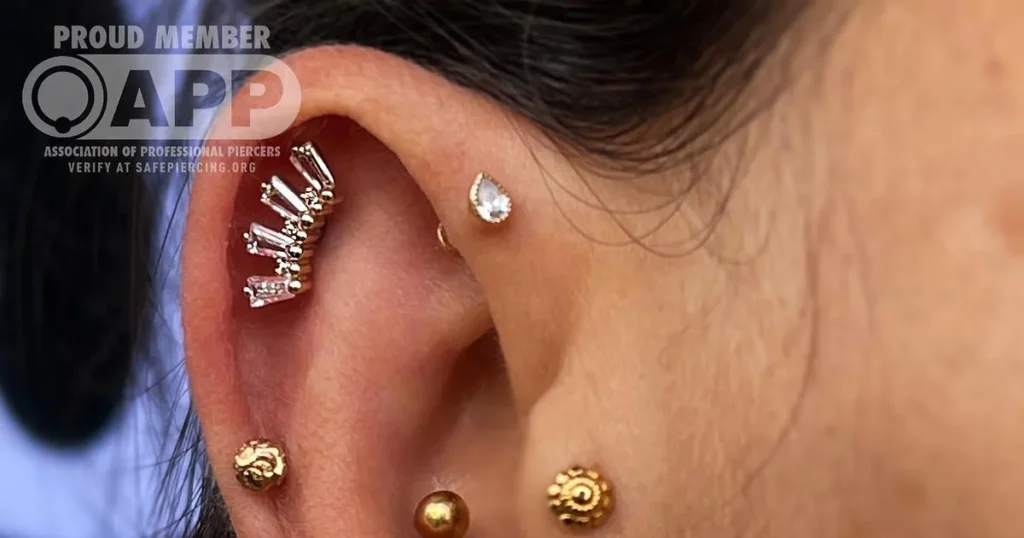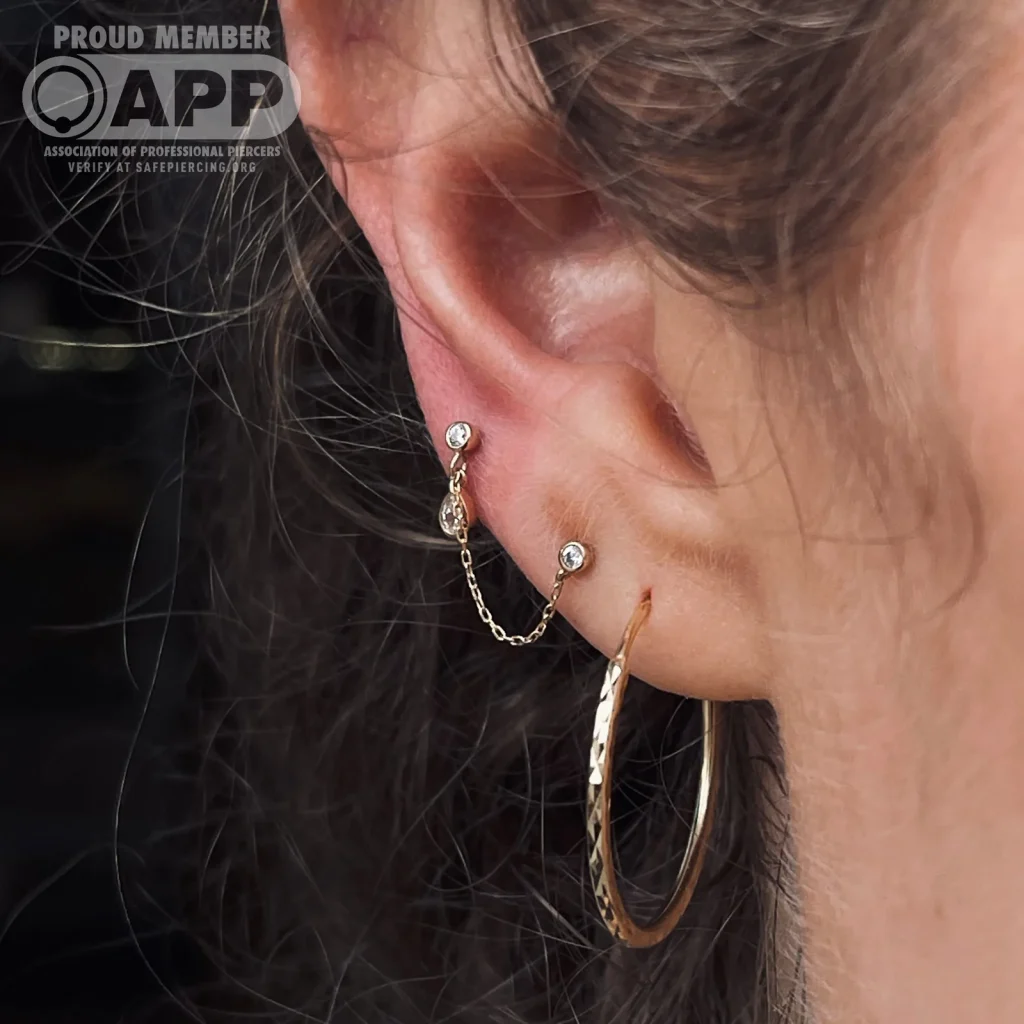

If you’ve been researching piercing studios, you’ve probably come across the phrase “APP member” without knowing exactly what it means, or why it should matter to your decision. The Association of Professional Piercers is the leading professional organization in the piercing industry worldwide, and membership isn’t a decorative certificate on the wall — it’s compliance with strict standards that are actually verified. This guide explains what the organization is, how a studio becomes a member, and why it should factor into your choice of where to get your next piercing.
What Is the Association of Professional Piercers (APP)
The APP was founded in the United States in 1994 as a non-profit, out of a clear need: at the time, professional piercing was barely regulated, and there was no single body setting standards for safety, hygiene, and training. A group of professional piercers decided to establish a body that would set a clear bar and share knowledge among practitioners around the world. Since then, it has grown to include hundreds of member studios across multiple countries, becoming the industry’s leading authority.
Unlike commercial certificates that can simply be purchased, membership requires meeting defined criteria and is renewed every single year — meaning a studio can’t just join once and coast on that status indefinitely.
What It Takes to Become a Member
Not every studio that applies gets accepted. The membership process includes detailed requirements that are actually verified, not just declared:
- Medical-grade sterilization — a proper autoclave, ongoing testing procedures (like spore tests), and organized documentation of every sterilization cycle.
- Implant-grade jewelry only — materials like ASTM F136 titanium and solid gold, not cheaper alloys that can cause irritation or allergic reactions.
- Single-use needles only — a total ban on reuse or on piercing guns, which can’t be properly sterilized.
- Documented training — the piercer in charge must demonstrate verified apprenticeship hours under an experienced piercer, not just self-taught experience.
- Informed consent procedures — including written consent forms, a clear minimum age policy, and documentation for every procedure.
- Facility inspection — the studio itself is reviewed for cleanliness, workstation organization, and proper separation between clean and dirty zones.
All of this is re-checked at every membership renewal, so a studio can’t quietly lower its standards after getting accepted and keep displaying the badge without continuing to earn it.
Before booking, you can simply ask the studio: “Are you an official APP member?” and ask to see documentation. A professional studio won’t dodge the question or struggle to show you.
Common Myths About Membership
Any certificate on the wall with the organization’s logo proves active membership.
Expired certificates, outdated ones, or ones copied from elsewhere prove nothing. You can — and should — check the organization’s official website for the current list of member studios.
A studio that isn’t a member is automatically unsafe or unprofessional.
There are highly skilled, experienced piercers who’ve chosen not to join, for various reasons. Membership is a strong indicator, not the only proof of quality.
Membership is a government license to practice piercing.
The APP is a voluntary professional organization, not a regulator. Legal licensing, where it exists, is determined separately under local law.
Why This Should Matter to You as a Client
The difference between an APP member studio and a non-member studio isn’t always visible at a glance. Two places can both look clean and professional at first impression, but the real difference lies in details you can’t easily check yourself: the actual quality of the jewelry, how often sterilization is tested, and the real training background of whoever is holding the needle. Official membership is an external, objective way of confirming that someone has already checked these things for you.
How This Looks at URBAN BODY
URBAN BODY is the first studio in Israel accepted as an official member. Avishay Shabtai, the studio’s founder, apprenticed under Fakir Musafar — widely regarded as the father of modern piercing and founder of the world’s first professional piercing school — and applies those principles in practice: implant-grade titanium and solid gold jewelry only, single-use needles, ongoing and documented sterilization testing (including a daily Helix test), and a structured informed-consent process before every procedure. Full details on our sterilization process are available in our sterilization guide.
If you’re deciding where to get your next piercing, you’re welcome to read more about our piercing studio, or get to know the full story of the studio.
Frequently Asked Questions
What exactly is the APP?
The Association of Professional Piercers is a non-profit professional organization founded in 1994 that sets standards for safety, hygiene, and training in the piercing industry worldwide.
Is membership a legal license to practice piercing?
No. It’s a voluntary professional commitment to the industry’s highest standard, not a government license. Legal licensing, if it exists, is determined separately by local law.
Does membership renew automatically?
No. The studio must renew its membership every year and meet all requirements again, including documentation of sterilization processes, jewelry quality, and staff training.
Is a non-member studio necessarily unsafe?
Not necessarily. There are skilled, experienced piercers who’ve chosen not to join. That said, official membership gives clients external, objective assurance they don’t have to verify themselves.
What’s the difference between compliant jewelry and regular jewelry?
Compliant jewelry is implant-grade — ASTM F136 titanium or solid 14K/18K gold only — as opposed to cheaper alloys that can cause irritation or allergic reactions and slow healing.
Who was the first APP member studio in Israel?
URBAN BODY is the first studio in Israel accepted as an official APP member.
The Bottom Line
Membership isn’t just a sticker on the door — it’s an ongoing verification process that requires a studio to meet the world’s strictest standards, over and over, every single year. When choosing a piercing studio, it’s worth asking whether they’re a member and asking to see the documentation. It’s one of the simplest, clearest ways to confirm your body is in good hands.
For more information and a list of member studios, visit the Association of Professional Piercers website.