Helix piercing is the most common cartilage piercing on the ear — and one of the most frequently mishandled. This guide covers the different helix placements, how long healing actually takes, which jewelry belongs in a fresh cartilage piercing, and what it costs at URBAN BODY, the first studio in Israel to hold official membership in the Association of Professional Piercers.
Quick facts
- Placement
- Outer rim of the ear cartilage
- Price
- ₪150 (jewelry separate, from ₪150)
- Full healing
- 12 to 18 months
- Downsize
- At 4–6 weeks, included in the service
- Initial jewelry
- Flat-back labret, ASTM F136 / F1295 titanium
- Switching to a ring
- Not before 6 months, usually around 12
- Method
- Sterile single-use needle only — never a gun
- Address
- 42 Bograshov St, Tel Aviv
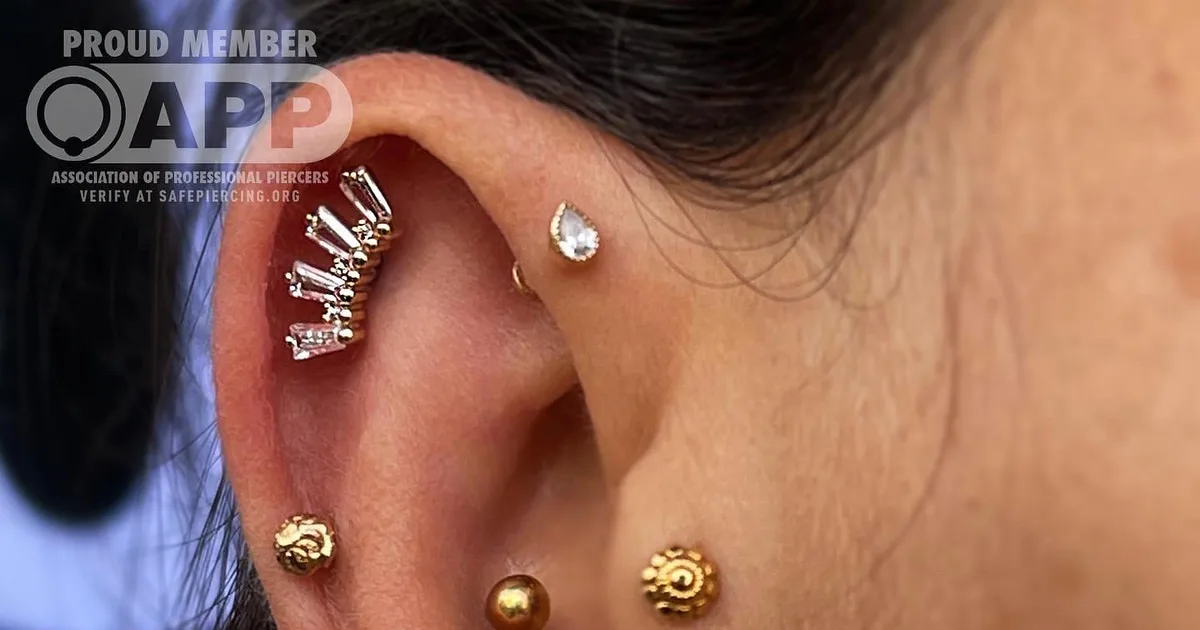
What is a helix piercing
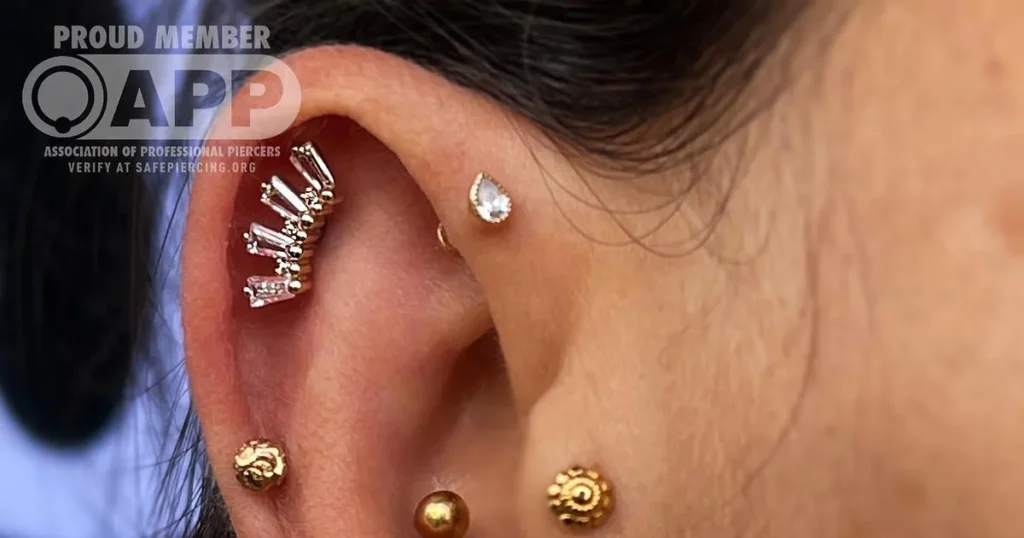
The helix is the curved outer rim of the ear — the arc that wraps around its upper edge. A helix piercing passes through the cartilage in that area, unlike a lobe piercing, which goes through soft tissue only.
That distinction matters more than it sounds. Cartilage has a limited blood supply, so it heals considerably slower than the lobe, reacts poorly to sustained pressure and friction, and is far less forgiving of unsuitable jewelry or a badly judged placement.
Types of helix piercing
"Helix" is an umbrella term. Underneath it sit several placements that differ significantly in anatomy and in how they heal:
| Type | Placement | What matters |
|---|---|---|
| Standard helix | Upper outer rim of the ear | The most common. Suits almost any anatomy. |
| Forward helix | Front edge of the rim, closest to the face | Cartilage thickness varies widely between individuals and is sometimes thinner than the outer rim. Requires anatomical assessment before deciding. |
| Flat | The flat inner surface of the ear, below the rim | Offers flexibility in positioning. Works as a single piercing or as part of a larger composition. |
| Double / triple helix | Two or three piercings along the rim | Possible in one session, but the spacing has to be planned precisely in advance. |
Before you settle on a placement — your anatomy decides. On some ears a particular position simply will not sit correctly, and the piercing will either migrate or produce irritated tissue. During a consultation we assess the structure of your cartilage before committing to a spot. It's free and carries no obligation.
How much does a helix piercing hurt
Contrary to popular belief, cartilage is not necessarily more painful than a lobe. Pain perception varies from person to person and depends on anatomy, the exact placement, and individual pain threshold. The piercing itself takes only seconds, and most clients describe a sharp, brief pressure rather than prolonged pain.
What genuinely differs with cartilage is the healing period, not the intensity of the pain. Expect tenderness to the touch and some discomfort sleeping on that side during the first few weeks. That's normal and doesn't indicate a problem.
Helix piercing healing time
This is where the most common mistake happens. Plenty of places promise healing in three months. That isn't accurate.
All ear cartilage, helix included, heals over 12 to 18 months. In the first three months the piercing looks healed from the outside, but the tissue inside is still rebuilding. Changing jewelry too early is the number one cause of irritation and irritation bumps.
One important milestone along the way: a downsize at 4–6 weeks. The initial piercing is performed with a longer post to leave room for swelling. Once the swelling subsides, that extra length starts to move and catch — so it needs to be swapped for a shorter post. This isn't a suggestion, it's part of the process, and the follow-up appointment is included in the service.
Throughout the healing period, avoid sustained pressure on the area — sleeping on that side, headphones, tight hats. If you wear glasses and have a forward helix or flat, pay particular attention: the arm of the frame rests directly on that spot. Remove them when you can, or switch to contact lenses temporarily.
For the full cleaning routine, signs of normal healing, and when to see a doctor, see our complete piercing aftercare guide . If you're still deciding between placements, the ear piercing types guide compares healing times across the whole ear.
Jewelry for a helix piercing
In cartilage, jewelry quality affects healing more than any factor other than placement.
- Material. Implant-grade titanium to ASTM F136 or ASTM F1295, or solid 14K/18K gold. Not plated steel, not nickel, not unidentified "white gold".
- Angle. The jewelry has to sit at 90° to the tissue. A piece sitting at an angle applies constant lateral pressure against the wall of the channel.
- Style. Fresh piercings are done with a flat-back labret, not a ring.
Why not a ring from the start
The curve of a ring places continuous pressure on the walls of the piercing — a circular shape simply doesn't match a straight channel that's still forming. That pressure, combined with the greater movement a ring allows, is one of the most common causes of irritation bumps.
What is an irritation bump? A small raised area that forms around the piercing as the tissue responds to sustained pressure and irritation. It is not an infection, and it usually does not require removing the jewelry — in most cases, eliminating the source of pressure, whether that's unsuitable jewelry, a bad angle, or external friction, allows it to settle and disappear. If a bump appears, come back to your piercer for assessment before attempting to treat it yourself.
When you can switch to a ring: not before six months, and in most cases around the twelve-month mark. The change is made after the channel has fully stabilised, ideally with your piercer, who will fit the correct diameter.
The studio stocks titanium jewelry from ₪150, alongside gold pieces from the leading manufacturers worldwide — BVLA, Anatometal, Buddha Jewelry, Industrial Strength and NeoMetal.
Helix piercing price
| Service | Price |
|---|---|
| Helix piercing | ₪150 |
| Forward helix / flat | ₪150 |
| ASTM F136 / F1295 titanium jewelry | From ₪150 |
| Consultation and anatomical assessment | Free |
| Follow-up and downsize | Included |
The price covers the procedure, sterile single-use equipment, a full explanation and aftercare instructions. Jewelry is selected separately according to material and design. Full pricing for every placement is listed on our piercing services page .
How many piercings in one session
Up to three piercings per session, with roughly two months between visits. This isn't an arbitrary limit — healing several cartilage sites simultaneously puts a heavier load on the body and extends the healing time for all of them.
If your goal is a planned set of piercings built up over time, that's what's known as a curated ear — designing the composition of the entire ear in advance rather than adding placements one at a time.
Where to get a helix piercing in Tel Aviv
URBAN BODY is located at 42 Bograshov Street in central Tel Aviv, walkable from most of the city centre:
- About a 7-minute walk from Dizengoff Center
- About 5 minutes from Bograshov Beach
- About 10 minutes from Sheinkin and Rabin Square
- Close to Ben Yehuda, Dizengoff and King George streets
We see clients from across the Tel Aviv metropolitan area — Tel Aviv, Ramat Gan, Givatayim, Herzliya, Bat Yam and Holon.
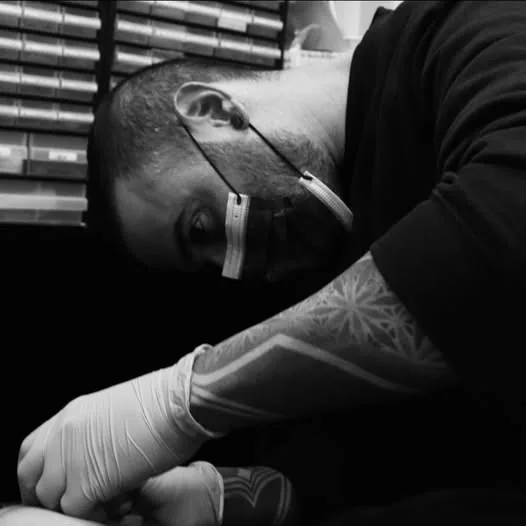
Written by Avishay Shabtai Founder of URBAN BODY and a professional piercer with over 20 years of experience. The first official member in Israel of the APP , the international professional piercers' organisation, and a student of Fakir Musafar.
Why get your helix pierced at URBAN BODY
- The first piercing studio in Israel with official APP membership
- Operating since 2003 — over 20 years of experience
- Implant-grade ASTM F136 and ASTM F1295 jewelry only
- Autoclave sterilization with a daily Helix test
- Free consultation and anatomical assessment, no obligation
- Follow-up and downsize included in the service
- Rated 4.9 out of 5 across more than 385 Google reviews
Frequently asked questions
How long does a helix piercing take to heal?
Twelve to eighteen months for full healing, like all ear cartilage. At 4–6 weeks a downsize is performed — swapping to a shorter post once the swelling has gone down.
How much does a helix piercing cost?
₪150 for the procedure, including sterile equipment, a full explanation and aftercare instructions. Jewelry is chosen separately and starts at ₪150 for implant-grade titanium.
What's the difference between a helix and a forward helix?
A standard helix sits on the upper outer rim of the ear. A forward helix sits on the front edge of that same rim, closer to the face. Cartilage thickness in the forward area varies considerably between individuals and is sometimes thinner, so the placement is only decided after an anatomical assessment.
Can I sleep on my side after a helix piercing?
Best avoided during the first few weeks. Sustained pressure on healing cartilage prolongs the healing process and can cause an irritation bump or push the jewelry to an incorrect angle. A travel pillow with a hole in the centre is a simple, effective solution. The same principle applies to headphones, tight hats and glasses.
When can I switch to a ring?
Not before six months, and in most cases around twelve months after the piercing. The curve of a ring puts pressure on the walls of the channel, which makes it unsuitable while the tissue is still forming. Have your piercer handle the change so the diameter is correct.
Can a helix be done with a piercing gun?
No. A piercing gun crushes cartilage tissue rather than piercing it, cannot be fully sterilised, and doesn't allow implant-grade jewelry to be used. The APP opposes the use of guns on cartilage without exception. We work exclusively with sterile single-use needles.
What should I do if a bump forms next to my helix?
A bump like that is usually a response to sustained pressure or irritation, not an infection. Don't remove the jewelry, and don't squeeze or pierce it. The right step is to return to your piercer for assessment — in most cases identifying and removing the source of pressure is enough for it to settle.
Not sure which helix suits you?
Free consultation and anatomical assessment, no obligation, at 42 Bograshov Street in Tel Aviv — about a 7-minute walk from Dizengoff Center.