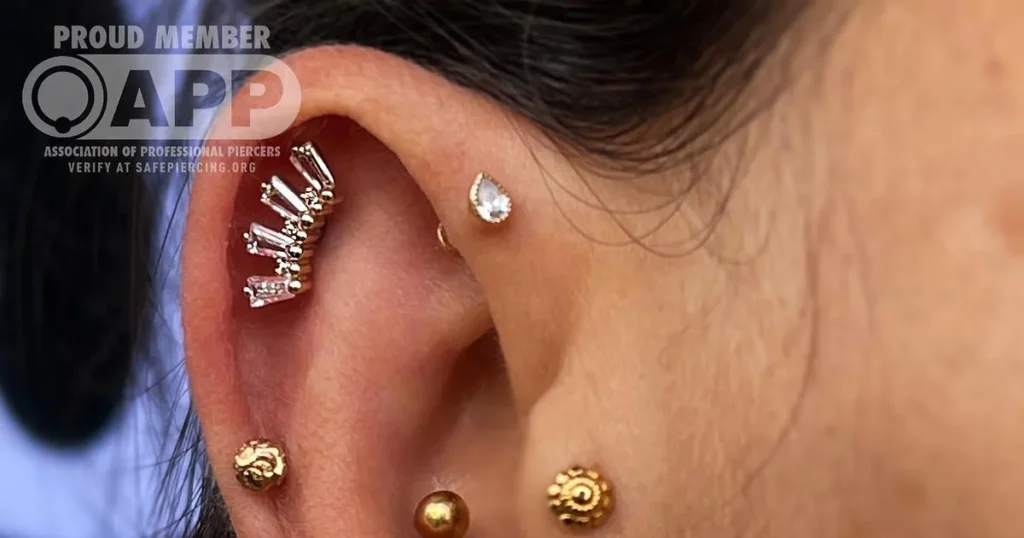
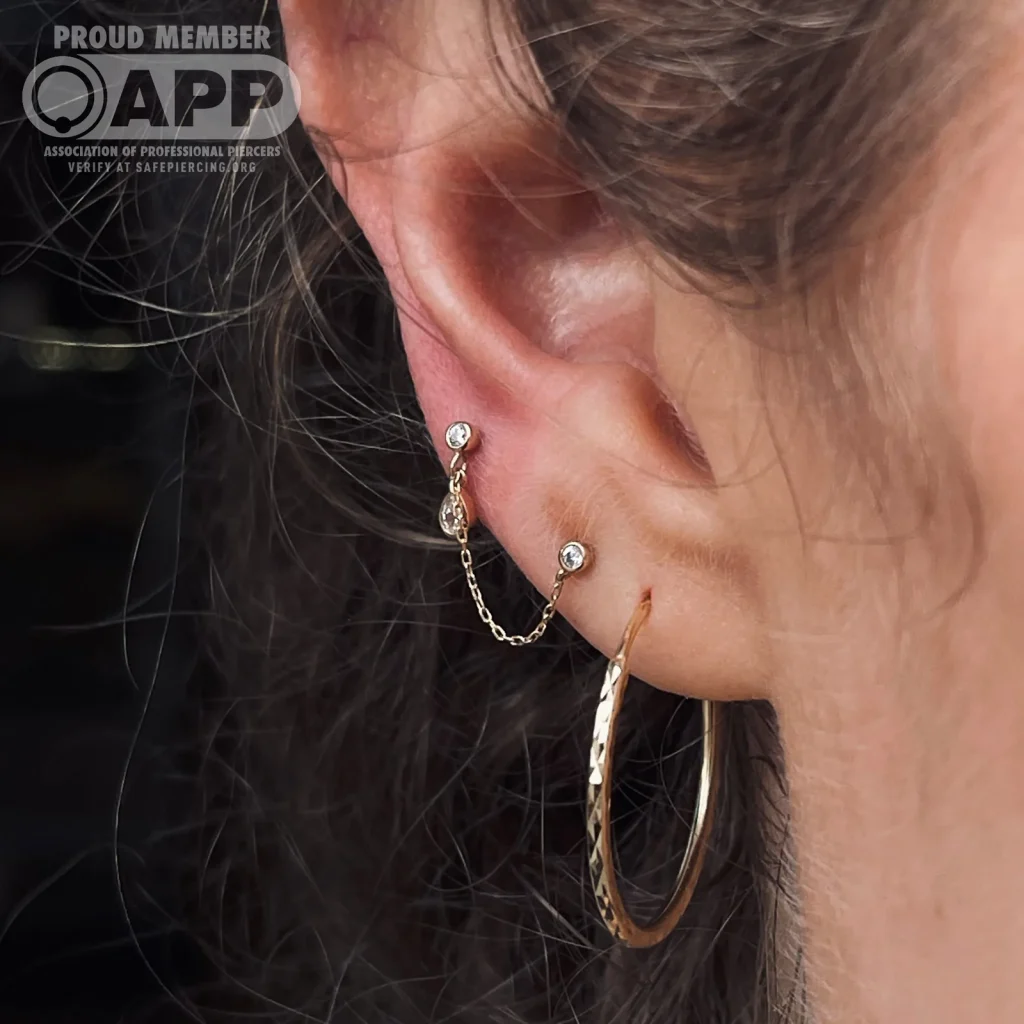
Ear curation means planning the ear as a whole — placements, jewellery and the order in which everything is done. It suits people starting from scratch, and just as much people who already have existing piercings.
This guide covers what actually determines the result: your individual anatomy, the angle of the piercing, jewellery selection, and realistic healing times for each area of the ear.
Key facts
- Lobe healing
- 3–6 months
- Cartilage healing
- 1 to 1.5 years (every area of the ear except the lobe)
- Maximum per visit
- 3 piercings
- Interval between visits
- About two months
- Downsize check-up
- 4–6 weeks after the piercing
- Correct angle
- 90 degrees to the tissue
- Materials
- ASTM F136 / F1295 titanium, solid 14K gold or higher
- 1Helix · cartilage
- 2Forward helix · cartilage
- 3Flat · cartilage
- 4Rook · cartilage
- 5Daith · cartilage
- 6Conch · cartilage
- 7Snug · cartilage
- 8Tragus · cartilage
- 9Antitragus · cartilage
- 10Lobe · soft tissue
- 11Industrial · cartilage
An ear with existing piercings can still be curated
Many of the people who come to us are not starting with a blank canvas. They already have piercings — some done years ago, not always in an ideal spot, not always at the right angle, and often not symmetrical between the two ears. The first question they ask is usually whether they have to give those up. In most cases the answer is no.
Three ways to improve an existing ear:
- Matching jewellery to where the hole actually sits. Jewellery in a shape and length suited to the existing angle and position can change the look completely — and sometimes ease a heal that never finished properly.
- Upgrading material and design. Moving from cheap jewellery to a compliant material and a design suited to the area changes the ear more than most people expect.
- Adding one considered placement. A further piercing in the right spot blurs existing asymmetry and turns it into part of a deliberate arrangement.
Every area of the ear is potential. Even an ear that looks "full" usually allows for options that were never considered — and each one is a piercing in its own right, with the healing process that belongs to its area.
Anatomy: not everyone can have every piercing
Ear structure differs from person to person. Ridges, folds and depth are not the same for everyone, and some piercings require a particular formation. Where it does not exist, the piercing will not hold: it will migrate, reject, or heal at the wrong angle.
That is why the assessment is always made on the ear itself, never on a drawing or a reference photo. We examine the structure and advise on what suits each person specifically — including saying that a given placement is not recommended for them.
Areas that require particular experience
Daith, industrial and similar projects sit at a different level of complexity. They demand precision in the angle, an exact match to the structure and experience in selecting the jewellery — and they do not suit every ear.
Want to know what suits your ear?
Anatomy is assessed on the ear itself. A short consultation at the studio will tell you which placements are possible and which are less so — 42 Bograshov St, Tel Aviv.
The angle: the detail that decides whether a piercing heals
If one thing separates a piercing that heals cleanly from one that gives trouble, it is the angle.
Jewellery needs to sit at 90 degrees to the tissue. Not nearly, not roughly. A perpendicular channel lets the jewellery sit without creating lateral pressure, and the tissue builds around it evenly. Achieving that angle on a curved cartilage structure takes skill and experience — and that is precisely the difference between an experienced piercer and someone who merely knows how to hold a needle.
When the angle is wrong, the jewellery presses on the tissue continuously. In most cases the result is an irritation bump that develops around one of the exit points. People tend to assume it is an infection or a reaction to the jewellery, but in practice the most common cause is the angle of the piercing.
Correct angle
The post crosses the tissue perpendicularly. No lateral pressure, and the tissue builds around it evenly.
Incorrect angle
The post presses on the walls of the channel throughout healing. A bump develops at the exit point.
What to do when a bump appears. Healing in this situation is long, and sometimes never finishes at all while the angle stays wrong — because the source of the pressure has not gone away. In these cases our recommendation is to remove the jewellery, let the area rest for about two months, and only then re-pierce at a correct angle. It sounds like a step backwards, but it is the fastest route to a sound result.
Two further details in execution affect healing just as much:
- Post length. Determined by tissue thickness and by the room needed for swelling. Too short presses; too long moves and snags.
- Jewellery matched to anatomy. Shape, diameter and size must suit the specific structure of the area — not a generic template.
Healing times for ear piercings
Apart from the lobe, every area of the ear is cartilage: helix, forward helix, flat, conch, tragus, antitragus, rook, snug, daith and industrial. Cartilage heals slowly, and full healing takes a similar length of time across all of these areas.
| Area | Tissue type | Full healing |
|---|---|---|
| Lobe | Soft tissue | 3–6 months |
| Helix | Cartilage | 1 to 1.5 years |
| Forward helix | Cartilage | 1 to 1.5 years |
| Flat | Cartilage | 1 to 1.5 years |
| Conch | Cartilage | 1 to 1.5 years |
| Tragus | Cartilage | 1 to 1.5 years |
| Antitragus | Cartilage | 1 to 1.5 years |
| Rook | Cartilage | 1 to 1.5 years |
| Snug | Cartilage | 1 to 1.5 years |
| Daith | Cartilage | 1 to 1.5 years |
| Industrial | Cartilage | 1 to 1.5 years |
A cartilage piercing may look healed long before that point, and this is one of the most common mistakes. Outward appearance says nothing about what is happening deeper in the tissue — which is why jewellery changes and the move to rings follow the timeline, not the feeling.
Pacing
The maximum we perform in a single visit is three piercings. This is a professional decision, not a scheduling limit: beyond three placements it becomes unnecessary trauma to the body and too much healing load on a small area.
The recommended interval between visits is about two months. That time lets the previous areas settle before new load is added.
- First visitUp to three piercings, following the plan marked out on the ear.
- 4–6 weeks laterFollow-up check and downsizing of the post if needed.
- About two months after the first visitSecond visit — up to three further placements.
- And so onUntil the plan is complete. Each stage gets its own check-up after 4–6 weeks.
From here it is clear why curating a full ear is a staged process — and why planning ahead is what lets each step land in the right place, rather than being worked around after the fact.
The follow-up check and downsizing
An initial piercing is fitted with a post longer than strictly needed, to leave room for the swelling of the first few days. Once the swelling subsides, that same post becomes a problem: it moves, catches on hair and clothing, and pulls the wound sideways.
We recommend coming in for a check after 4–6 weeks and shortening the post if needed. It is a quick appointment that prevents healing at the wrong angle and problems that are very hard to correct later.
Jewellery: part of the process, not just the look
The jewellery sits inside an open wound for the entire healing period. Its material and its connection are part of the medical process, exactly like the technique.
Materials for an initial piercing
- ASTM F136 titanium (Ti-6Al-4V ELI)
- ASTM F1295 titanium (Ti-6Al-7Nb)
- Solid 14K gold or higher, nickel-free — not plated and not gold-filled
These standards are not our invention: they are the list of materials the Association of Professional Piercers approves for initial piercings.
Connection method
- Threadless (press-fit) — the surface is smooth on entry and on exit
- Internal threading — sound; the threading sits inside the post
- External threading — not suitable for piercing. The exposed threading is dragged through the wound at every change
Threadless
The pin press-fits into the post. Every surface that passes through the tissue is completely smooth.
Internal threading
The threading is hidden inside the post. Here too the outer surface that touches the tissue is smooth.
External threading
The threading is exposed on the body of the post and is dragged through the channel at every change. Not suitable for piercing.
Our jewellery comes from manufacturers who produce to these standards and supply full material documentation:
- Industrial Strength
- Neometal
- BVLA (Body Vision Los Angeles)
- Buddha Jewelry
- Anatometal
- LeRoi
- Glasswear Studios
How we work
- Examining the ear. Structure, ridges, depth — and where there are existing piercings, their position and angle too.
- Personal consultation. What suits your structure, what suits it less, and which options you had not considered.
- Marking the plan on the ear, including placements to be done in future.
- Splitting into stages — up to three piercings per visit, about two months apart.
- Selecting jewellery for the initial piercing, plus an end goal for each placement.
- A check-up after 4–6 weeks to downsize the post if needed.
Full pricing details are in our price guide.
Frequently asked questions
I already have piercings in my ear — can it still be curated?
Yes, and it is a very common case. Existing piercings that were not placed ideally or are not symmetrical can usually be improved by choosing suitable jewellery and matching it to the existing anatomy and angle. Adding a further placement in a considered spot can blur asymmetry and complete the overall look.
I have a bump on my ear piercing — what should I do?
In most cases the bump forms because of an incorrect piercing angle that puts continuous pressure on the tissue — not because of an infection. As long as the angle is wrong, healing will be long and sometimes will not finish at all. Our recommendation in that situation is to remove the jewellery, let the area rest for about two months, and only then re-pierce at a correct angle.
What angle should the jewellery sit at?
At 90 degrees to the tissue. A perpendicular channel lets the jewellery sit without lateral pressure, and the tissue builds around it evenly. Achieving that angle on a curved cartilage structure takes skill and experience, and it is one of the main factors in a successful heal.
How many piercings can be done in one visit?
We perform up to three piercings per visit. Beyond that it becomes unnecessary trauma to the body and too much healing load on a small area. The recommended interval between visits is about two months.
How long does an ear piercing take to heal?
A lobe heals within three to six months. Every other area of the ear is cartilage — helix, forward helix, flat, conch, tragus, antitragus, rook, snug, daith and industrial — and full healing usually takes one to one and a half years.
When should I come in for the check-up and downsize?
After 4–6 weeks. An initial piercing is fitted with a longer post to allow room for swelling, and once that subsides the post should be shortened if needed. A post that is too long moves, snags and pulls at the wound.
Why was I told a particular placement does not suit me?
Ear structure differs from person to person. Some piercings require a specific ridge or fold, and if it does not exist or is too flat, the piercing will migrate, reject or heal at the wrong angle. We examine the ear and advise on what suits that specific structure.
Which ear piercings are considered more complex?
Daith, industrial and similar projects. They require precision in the angle, an exact match to the structure and experience in selecting the jewellery, and they do not suit every anatomy.
Which jewellery is suitable for a fresh piercing?
ASTM F136 or F1295 titanium, or nickel-free solid 14K gold or higher. The connection should be threadless or internally threaded. External threading is not suitable, because the exposed threading is dragged through the wound at every change.
Consultation and planning
An examination of the ear, advice based on your individual structure, and a staged plan — including for people who already have existing piercings. 42 Bograshov St, Tel Aviv.
Ready to plan your ear? Book a consultation at our piercing studio in Tel Aviv.